case file 14 · a personal software factory

Burrow.

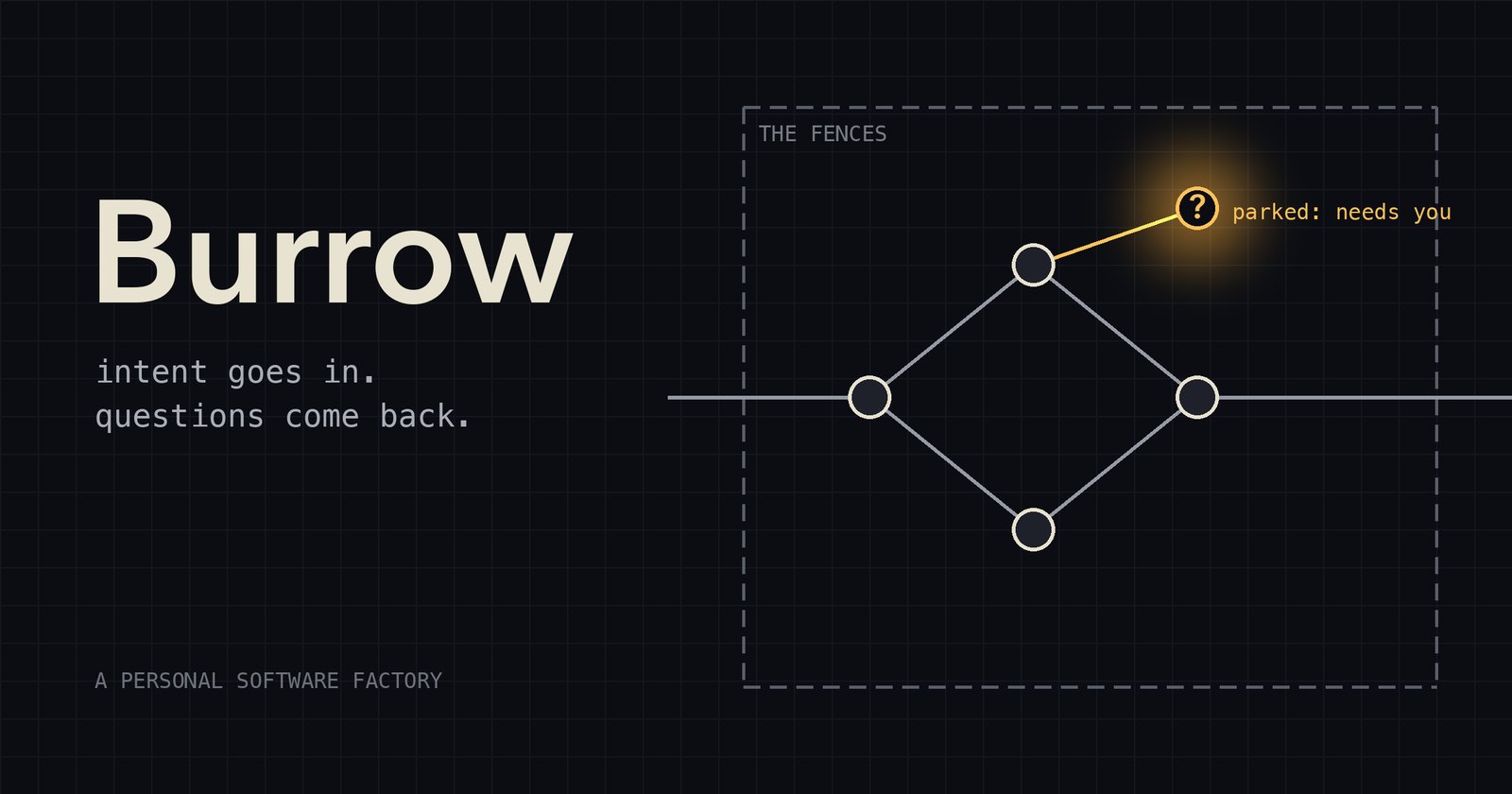
My own automation driver. Work comes in, walks a path I drew, and comes back either done or with a question only I can answer. I supervise. It works inside the fences I built for it.

running · on my own machines
§ what it is

I wanted to supervise work, not do it twice.

Most of my evenings used to look the same: an idea, a ticket or a review comment arrives, and I sit with an agent and walk it through the same dozen steps I walked the last one through. The models got good enough that the typing wasn't the bottleneck any more. I was.

Burrow is what I built instead. Work arrives from the places it already lives — a card on a board, a comment on a pull request, a timer, a folder — and each kind of work follows a path I drew once: named steps, in order, each one checkpointed, so a crash or a reboot picks up where it left off rather than starting over.

The models are workers at specific steps, not the boss of the whole thing. That's the line I keep coming back to: a lot of agent systems are a model deciding what to do next. Burrow is a path deciding what the model does next.

I touch it in exactly two places. Intent goes in — what I want and why. Questions come back — the things only I can decide. Everything between those two is Burrow's job, and a screen on my phone shows what's moving, what's waiting, and what's waiting on me.

01

The fences are mechanical

“It passed” only counts when a real check says so. What can merge, what files can change, what has to be verified first — those are rules the machine enforces, never things a model gets to declare.

02

It parks instead of guessing

When something's genuinely my call, the work stops and asks — and the question has to be one only I can answer. A failed check gets a few honest retries first. Guessing isn't one of the options.

03

Two sets of eyes

I review for intent: is this what I wanted? A second reviewer, deliberately not the one that did the work, reviews for correctness. Neither of us has to do the other's job.

§ my musings

Speed over caution, with free guardrails.

A guardrail that costs nothing stays. A gate that costs my attention has to earn it.

The tempting way to make automation safe is to put a human in front of every step. That just rebuilds the job you were trying to leave, with more clicking. So the rule I ended up with is about cost. Anything the machine can check for free — a test, a path allowlist, a diff that has to apply cleanly — is always on. Anything that needs me has to be worth interrupting me for, or it goes.

The other rule is about where text comes from. Anything that arrived from outside — a ticket, a comment, a web page — is treated as data, not instructions, no matter who sent it. That's not about trust in people. It's about never letting a sentence in someone's ticket become a command.

What I didn't expect is how much it changed what I build. Know That? exists because Burrow can turn a question into a finished episode on a timer and hand me only the part that's mine: does this one go out? It keeps my notes vault fed, too. A queue that forgets is just cron with opinions; a second brain that nothing feeds is just a wiki. Burrow can even improve its own paths and docs — just not its own engine. Some fences you don't hand the keys to.
← prev case fileKnow That? next case file →Ember